
Using a surrogate and donor eggs with your own sperm
Using a surrogate may be a viable option if becoming pregnant or giving birth is undesirable, medically inadvisable or dangerous.
How does it work?

Surrogacy with donor eggs
Using a surrogate – alongside in vitro fertilisation (IVF) with donor eggs and your own sperm – could help you realise your dream of becoming a parent. The option of surrogacy – using donor eggs – also opens up the possibility of parenthood to single people, same-sex male couples, women who are at risk of passing on an inherited or genetic disorder, and heterosexual couples.
Donor eggs may also be indicated if you
- Have had cancer treatment and do not carry any eggs
- Carry genes for an inherited and serious health condition
- Have had a premature menopause
- Were born without functioning ovaries
- Have ovaries resistant to stimulation
- Are an older woman (>44 yrs)
Of course, it can be a difficult decision to use a surrogate and donor eggs, but be reassured that we will help and guide you through every step of your journey.
Your surrogacy journey
You may already have a trusted friend or family member who is willing to be your surrogate. If not, you will need to find a ‘host’ surrogate through a specialist agency. Although we are not legally permitted to find a host for you, we can provide information on the agencies that can help you.
You will need to source donor eggs for your IVF treatment.
- Donor eggs – If you are using donated eggs, you will need to decide if you want to source them from a known or unknown donor. We will guide you through both options, but if you prefer an unknown egg donor, we can help you find one through our innovative egg donor programme.
- Your surrogate – The surrogate will need to take fertility drugs to prepare her uterus for implantation. She will also need to make a number of visits to the clinic.
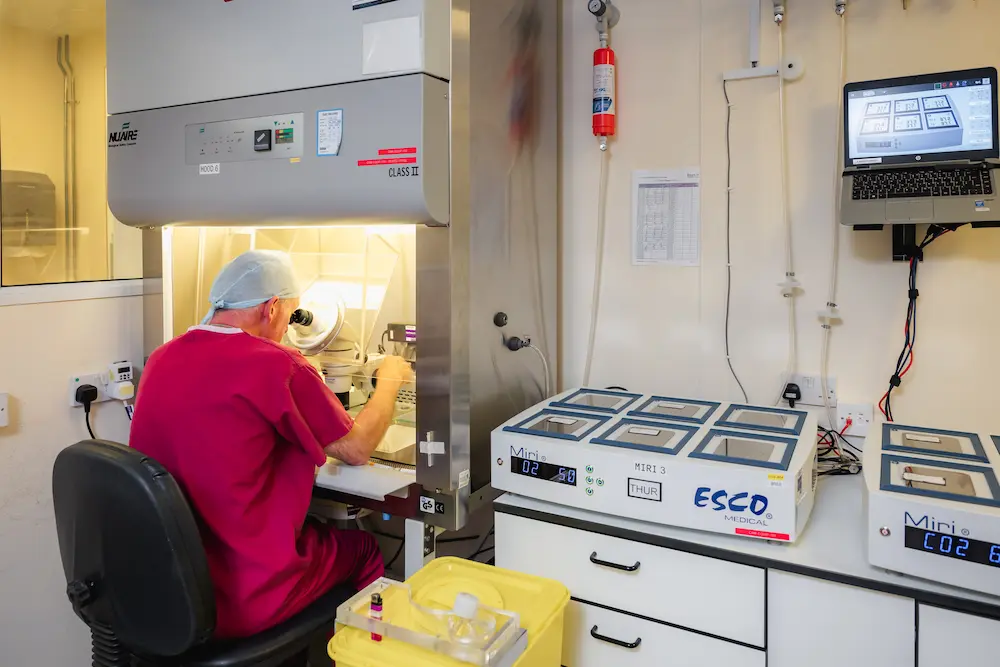
- Embryo fertilisation and transfer – The donor eggs and sperm will be placed in a culture dish where fertilisation will take place. The embryos will then be examined under a microscope and one or two viable embryos will be selected and transferred into the surrogate’s uterus. The remainder may be frozen for later use.
- Intracytoplasmic sperm injection (ICSI) – This procedure may be used if previous IVF attempts have failed. ICSI involves a single sperm being injected into each donor egg. After successful fertilisation, one or two viable embryos will be transferred to the surrogate’s uterus.
- Preimplantation genetic testing for Aneuploidy (PGT-A) – This is a screening method to make sure only the most viable embryos – those which when analysed contain the correct 23 pairs of chromosomes – are transferred into the surrogate’s uterus.
- Intracytoplasmic morphologically-selected sperm injection (IMSI) – Our embryologists will use enhanced magnification to check for any defects or abnormalities so only the healthiest sperm will be used for the ICSI method of IVF.
Preserving embryos gives you options, especially if you think you may want a child in the future.
- Frozen embryo transfer (FET) – This is the transfer of good quality embryos that have been frozen during a previous round of IVF. This method avoids the need to repeat an entire IVF cycle if pregnancy is deferred at the time of the IVF cycle.
Our specialist fertility experts tailor our services specifically to your needs.
Miscarriage clinic – The clinic is available to anyone who has experienced the devastation of an early pregnancy loss.
Your stories
Hear from our patients as they share their paths to parenthood.

April & Giacomo’s Fertility Journey: Overcoming Male Factor Infertility Challenges
April and Giacomo’s journey to parenthood was filled with uncertainty, waiting, and emotional challenges, but throughout it…

From Challenges to Joy
Every fertility journey is different, and for Kim and her husband, the path to parenthood brought both…

Sophie’s Journey to Motherhood: Becoming a Solo Mum with Donor Treatment
At Bourn Hall, we’re privileged to support people on every path to parenthood. Today, we’re sharing Sophie’s…
We are here to support you
At Bourn Hall your wellbeing is our priority, and this goes far beyond your fertility treatment.
We understand the frustration and distress that can sometimes be overwhelming during fertility treatment, so we encourage a holistic approach to your emotional and mental health. Engaging with our specialist advisors and counsellors is always encouraged and we run a Fertility Support Group for those who wish to share their experiences. We provide tailored nutritional support during fertility testing and we also promote a positive lifestyle approach throughout, including the benefits of being outdoors with nature.
Be reassured, we are here to help. Through all aspects of your journey, we will guide and support you, and give you all the information you need to help make your dreams come true.
Support at every stage
As one of the UK’s top fertility treatment centres, our values ensure we put our patients first.

Passion

Adaptability

Commitment

Teamwork and Collaboration
Our fertility milestones

1978
The world's first IVF baby

1980
Year founded by IVF pioneers

25000
Babies born through Bourn Hall

Upcoming fertility events
Join our experts at a range of events including support groups, webinars and open evenings.
Learn more about the options available to you, from fertility tests to treatments, and find answers to any questions you might have.







Frequently asked questions
Your questions answered. Find clarity on every step of your fertility journey.
Surrogacy involves one person carrying a baby on behalf of someone else. In gestational surrogacy, the embryo is created using the intended parents’ or donors’ eggs and sperm, so the surrogate has no genetic link to the baby. In partial surrogacy, the surrogate’s own egg is used, meaning she is genetically related to the child.
At Bourn Hall, we provide clinical guidance and education about choosing a suitable surrogate and understanding the process. However, under guidance from the Human Fertilisation and Embryology Authority (HFEA), fertility clinics cannot match intended parents with surrogates.
Some people choose a friend or family member to be their surrogate, while others connect with someone independently. Whatever your situation, our team will make sure you have the information and support to move forward with confidence.